
Why Shop Small for Paper Goods: A 2026 Guide
Mitchell AdelmanTable of Contents
- The Real Impact of Shopping Small for Paper Goods
- The Benefits of Supporting Small Creative Studios
- Why Buy Handmade Stationery Over Mass-Produced Options
- Supporting Deaf-Owned Businesses: A Different Perspective
- How Small Paper Goods Businesses Keep Money Local
- The Maker Economy and the Psychology of Gift-Giving
- How to Identify Truly Small Paper Goods Businesses
- Frequently Asked Questions
Last Updated: September 22, 2026
The Real Impact of Shopping Small for Paper Goods
When you shop small for a greeting card from a studio, you're not just buying paper. You're funding a person's craft, keeping money in your neighborhood, and getting something made with actual care. That's the short version of why shop small for paper goods matters. This guide from Cerulean Rooster walks through what your purchase actually supports, from local tax revenue to the maker economy, and how to tell a truly small operation from a big one wearing a handmade costume.

The difference shows up fast. A card from a big-box shelf was designed by committee, printed in bulk, and shipped through three warehouses before it reached you. A card from a small studio was drawn by a person, printed in small batches, and packed by hand. Completely different story inside it.
Below, we'll break down the real impact, the quality gap, and the questions to ask before you buy.
The Benefits of Supporting Small Creative Studios
Small creative studios put money back into the local economy in ways big retailers don't. When you buy from an independent maker, a larger share of that money stays in the community. Owners spend at nearby shops, hire local help, and pay local taxes. Economists call this the multiplier effect: each dollar spent locally circulates through the neighborhood several more times before it leaves.
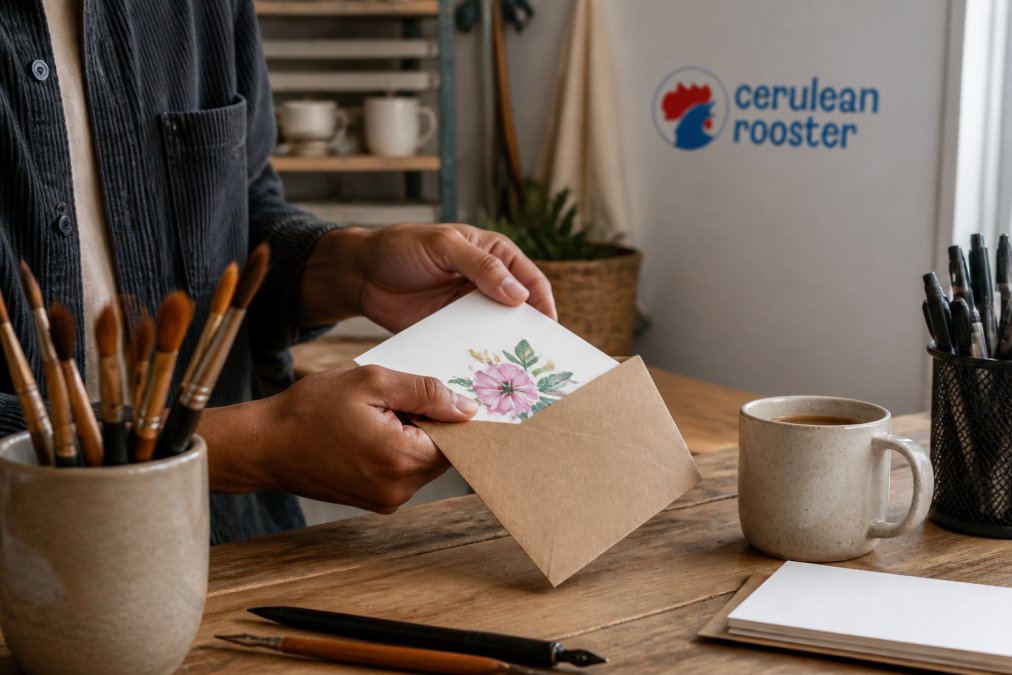
Personalized service is the other half of the equation. When you email a small studio with a question, a real person answers. Often the same person who drew the card. That's not a marketing line at Cerulean Rooster, it's just how a two-person studio works. Every order is packed by hand in our small studio, so the person sealing your envelope is the person who made what's inside.
Pros of buying from small creative studios:
- Direct contact with the maker
- Money stays in the local economy
- Unique designs you won't see in every store
Cons to expect:
- Smaller inventory, so popular designs sell out
- Slightly longer turnaround on custom work
- No same-day shipping option
Why Buy Handmade Stationery Over Mass-Produced Options
Handmade stationery is paper goods produced in small batches by an individual maker or small team, rather than printed in bulk by a large manufacturer. The difference is visible the moment you hold both in your hands.
The Quality Difference You Can Feel
Mass-produced cards often use thin paper and flat, uniform printing. Handmade stationery tends to use heavier cardstock and designs with real texture and color variation. When you run your thumb across a hand-painted design printed on premium stock, you feel the difference immediately. The colors hold up better, and the card doesn't buckle when you write inside it. Our Four Seasons Greeting Card Bundle, for example, is printed on premium cardstock.
A common mistake buyers make is judging a card by the cover photo alone. Ask about the paper weight and printing method instead. That's what determines whether a card feels like a keepsake or a throwaway.
The Environmental Footprint of Small-Batch Production
Small-batch production creates less waste than mass manufacturing. A small studio prints what it needs, not what a warehouse forecast demands. That means fewer unsold cards headed for the landfill and shorter shipping distances overall. Sustainable sourcing is easier to manage at a small scale, because the maker knows exactly where the paper comes from.
This isn't a perfect system. Small studios still ship orders and still use packaging. But the environmental footprint of a hand-packed envelope from a nearby studio is smaller than a pallet of cards trucked across the country.
Supporting Deaf-Owned Businesses: A Different Perspective
Deaf-owned businesses bring a perspective to design that's hard to replicate. Cerulean Rooster is a family-run creative studio owned by two deaf brothers, an artist and an attorney, who build every piece around visual storytelling. Expressive art is our medium of communication, and that shapes how we design: bold color, clear imagery, and cards that say the feeling without needing a paragraph of text.
Supporting deaf-owned businesses also means supporting economic participation in a community that faces real barriers to traditional employment. When you choose a deaf-owned studio, you're backing a business model built on skill and craft, not charity. The work stands on its own.
How Small Paper Goods Businesses Keep Money Local
Money spent at a small paper goods business stays closer to home than money spent at a national chain, and the paper goods category makes that stickiness unusually visible. A greeting card studio buys cardstock, envelopes, ink, and packaging. It hires local help for packing and shipping during holiday rushes. It pays local taxes on a storefront or studio space. Each of those transactions is a second and third stop for the same dollar before it leaves the area.
U.S. Small Business Administration guidance on small business impact outlines how small firms anchor local employment and community investment. That civic engagement is part of why neighborhood vibrancy tends to rise around a healthy cluster of independent shops.
Here's what that looks like in practice:
| What You Buy | Where the Money Goes | Local Impact |
|---|---|---|
| Card from a small studio | Maker, regional paper supplier, local taxes | Stays in the community |
| Card from a big-box store | Corporate HQ, national supply chain | Leaves the area quickly |
| Custom commission | Maker's time, local shipping | Direct to a neighbor |
The paper-goods-specific twist is that small studios tend to source locally more often than other retail categories, because paper, ink, and packaging are heavy and cheap to buy close to home. A studio that prints in small batches can order 200 sheets of cardstock instead of a pallet from overseas. That single sourcing decision keeps a larger share of each purchase inside the local supply chain, which is the multiplier effect working at the scale of a single card.
The Maker Economy and the Psychology of Gift-Giving
The maker economy is the growing market of independent creators who sell what they make directly to buyers. It's powered by conscious consumerism: shoppers who want to know who made their goods and how. For paper goods, that shift matters more than most people realize, because paper is the rare category where the maker's hand is still visible in the finished product.
Gift-giving psychology explains why. Research on emotional connection and gift value suggests that recipients rate thoughtful, personal gifts more highly than generic ones, because the gift signals effort and attention. American Psychological Association research on gift-giving and relationships explores how the thought behind a gift shapes how it's received.
That's the real case for artisanal paper goods. You're not just buying stationery. You're buying evidence that you paid attention.
How to Identify Truly Small Paper Goods Businesses
Truly small paper goods businesses share a few tells. You can spot them in about two minutes of browsing.
- The shop names the actual maker or makers
- Product photos show the studio, not just a white backdrop
- Designs repeat across a recognizable style
- Restocks are limited and sell out
- Customer service replies come from a person, not a ticket system
- The "about" page explains how the work is made
Frequently Asked Questions
What are the benefits of buying paper goods from small businesses?
Buying from small businesses keeps more money in your community and supports real people behind the products. You get unique, handcrafted items instead of mass-produced designs, and your purchase helps independent makers stay in business. Small studios often use sustainable sourcing and small-batch production, which reduces waste. You also get personalized service and the chance to build a relationship with the maker, something you will never get from a big-box retailer.
Why is handmade stationery higher quality than mass-produced options?
Handmade stationery typically uses premium cardstock and careful printing methods that mass production skips. Small-batch studios also choose materials for how they feel and hold up over time, not just for cost. When you buy handmade stationery, you are paying for attention to detail and durability.
How does shopping small support independent artists and the local economy?
When you shop small, the artist or studio owner gets a direct share of the sale, which helps them keep creating. That money then circulates through the local economy as they pay for supplies, shipping, and everyday expenses. Supporting deaf-owned businesses adds another layer by backing creators from communities that face extra barriers in traditional retail.
What is the environmental impact of choosing small-batch paper goods?
Small-batch production usually means less overstock and less waste. Many small paper goods makers also choose recycled or sustainably sourced paper and pack orders by hand with minimal plastic. Fewer middlemen in the supply chain can mean a smaller environmental footprint overall compared to large-scale manufacturing and distribution.
Shopping small takes a little more effort than grabbing a card off a shelf. You have to find the studio, check the turnaround, and sometimes wait a few extra days for a custom piece. What you get back is a card someone actually drew, packed by the same hands that made it. At Cerulean Rooster, every order is packed by hand in our small studio, with original art from two brothers who put real feeling into the work. Browse the full collection and find a card that says what you mean.