
Why Buy From Family Run Studios: 2026 Guide
Mitchell AdelmanTable of Contents
- Why Buy From Family Run Studios? The Case for Human-Made Art
- The Benefits of Supporting Small Businesses in Your Community
- Why Buy Handmade Art Instead of Mass-Produced Goods
- What a Deaf Owned Small Business Brings to the Table
- Pros and Cons of Buying From Family Run Studios
- How to Spot an Authentic Family Run Studio
- Conclusion: Making Your Purchase Count
- Frequently Asked Questions
Last Updated: September 14, 2026
Why Buy From Family Run Studios? The Case for Human-Made Art
When you buy from family run studios, you're not just purchasing a product. You're investing in a story, a relationship, and a piece of art that carries the fingerprints of the people who made it.
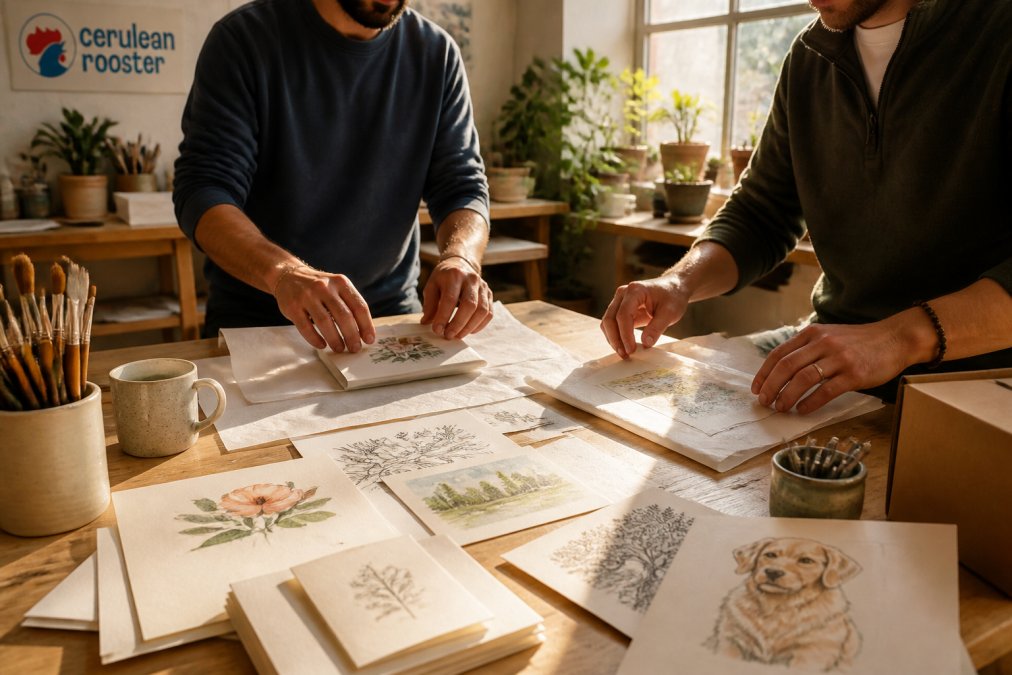
Family run studios are creative businesses owned and operated by relatives who share both the work and the rewards. Unlike large manufacturers, these studios keep decision-making close to the people actually making the art. That means every choice, from the paper stock to the color palette, reflects a real person's judgment rather than a committee's.
The case for buying from these studios comes down to one thing: care. A mass-produced greeting card is designed to be cheap and fast. A card from a family studio is designed to mean something. According to research on consumer values from Pew Research Center, a growing share of buyers say they prefer supporting small, local, and independent businesses when given the choice.
There's also a practical side. When you buy from a small studio, you can often talk directly to the maker. You can ask questions. You can request something custom. Try doing that with a big-box retailer.
The Benefits of Supporting Small Businesses in Your Community
Money spent with a family studio stays closer to home. That's not just a slogan, it's a measurable pattern. When you buy from a small, locally owned studio, a larger share of each dollar recirculates through nearby suppliers, service providers, and wages than when you buy from a national chain, where profits typically flow to distant headquarters and shareholders (sba.gov). Economists call this the local multiplier effect, and it's one of the quiet benefits of supporting small businesses.
Here's what that looks like in practice at a studio like ours:
- Materials come from nearby vendors. We buy paper, ink, and packing supplies from suppliers.
- Shipping and fulfillment stay local. We pack and ship every order ourselves rather than routing through a third-party fulfillment warehouse.
- Wages stay in the neighborhood. The people who make your card or portrait live in the same community where the studio operates.
Small studios also tend to hire locally when they grow, and they often partner with other vendors. Each purchase creates a small ripple that a big-box transaction doesn't.
Beyond economics, there's a cultural benefit that's harder to quantify but just as real. Small studios preserve skills that big factories have abandoned. Watercolor technique and careful packaging are crafts that survive because someone decided to keep doing them. When those skills disappear from a community, they rarely come back.
There's also a resilience argument. Small studios can adapt quickly, changing a product line, taking on custom work, or pivoting to a new medium, because decisions don't have to travel through layers of management.
Finally, there's the relationship piece. When you buy from a family studio, you're not a transaction in a database. You're a person the maker may remember. That connection is why so many buyers come back, not just for the product, but for the feeling of being part of something smaller and more human.
Why Buy Handmade Art Instead of Mass-Produced Goods
Handmade art carries something a factory print never will: variation. Every piece is slightly different because a human made it. That imperfection is the point.
When you buy handmade art, you're getting a one-of-a-kind object. A watercolor painting like our Winter Queen Original Art exists exactly once. There is no second copy sitting in a warehouse. That scarcity is what makes it worth owning.

Mass-produced goods are built for volume. They're consistent, cheap, and disposable. Handmade goods are built for meaning. They're personal, durable, and worth keeping.
Here's how the two compare:
| Factor | Handmade Art | Mass-Produced Goods |
|---|---|---|
| Uniqueness | One-of-a-kind | Identical copies |
| Maker connection | Direct to artist | Anonymous factory |
| Materials | Often chosen by hand | Chosen for cost |
| Longevity | Kept for years | Often discarded |
| Story | Personal, traceable | Generic |
The trade-off is real. Handmade takes longer and costs more. But what you get back is a piece with a life behind it.
What a Deaf Owned Small Business Brings to the Table
A deaf owned small business brings a distinct perspective that shapes the work itself. At Cerulean Rooster, we're two deaf brothers, an artist and an attorney, and everything we make comes from that shared experience.
Expressive art is our medium of communication. When words aren't the primary tool, visual storytelling becomes sharper. Our illustrations lean on gesture, color, and emotion because that's how we've always connected with the world.
Buying from a deaf owned small business also supports economic inclusion. Deaf entrepreneurs often face barriers that hearing business owners don't, from communication access to limited networking. Every order helps level that field.
The National Deaf Center documents how entrepreneurship offers deaf individuals a path to economic independence and creative control. Choosing to buy from these businesses is a small but meaningful vote for that path.
Pros and Cons of Buying From Family Run Studios
Buying from a family run studio is a trade-off, and it's worth being honest about both sides.
Pros:
- Personal service and direct communication with the maker
- Unique, one-of-a-kind pieces you won't find elsewhere
- Higher quality control because the maker signs off on every order
- Your money supports a real family, not a shareholder
Cons:
- Higher prices than mass-produced alternatives
- Longer turnaround times, especially for custom work
- Limited inventory, so popular pieces sell out
- Smaller teams mean less capacity during busy seasons
The pros usually outweigh the cons for buyers who value meaning over speed. But if you need fifty identical cards by Friday, a family studio may not be your best fit.
How to Spot an Authentic Family Run Studio
Start with the makers. An authentic studio will tell you who makes the work, often with a photo or a short bio. If the "artist" is unnamed, that's a red flag. At a genuine family studio, the people who own the business are usually the same people who make the product.
Check the product photos for variation. Real handmade goods show slight differences between items, a brushstroke that lands differently, a color that shifts, a line that isn't perfectly straight. If every photo looks identical, you may be looking at dropshipped goods or mass-produced items with a handmade label.
Read the about page for specifics, not sentiment. A genuine family studio will talk about its history, its people, and its process. Vague language about "passion" without specifics is a warning sign. Look for details like when the studio started, who does what, and how the work is actually made.
Look at how they handle questions. A family studio will answer you personally. A reseller will send a template or route you to a chatbot. The quality of the response tells you a lot about the quality of the operation.
Ask about quality control. At a family-run studio, the maker signs off on every order before it ships. There's no quality-control department to blame, the person whose name is on the work is the person who inspects it.
Check for a real return or redo policy. Family studios stand behind their work. If something arrives damaged or doesn't match what you expected, a genuine studio will make it right, often without a fight. A reseller will point you to a policy page and hope you give up.
Watch for these red flags:
- No named maker anywhere on the site
- Product photos that look identical across every listing
- An about page with no dates, names, or process details
- Customer service that only responds with templates
- No clear policy for damaged or unsatisfactory orders
None of these alone proves a business is fake. But two or more together usually means you're not dealing with a family studio, you're dealing with a storefront.
Conclusion: Making Your Purchase Count
Every purchase is a small vote for the kind of world you want to live in. When you buy from family run studios, you're choosing craftsmanship over convenience, people over profit margins, and meaning over mass production.
At Cerulean Rooster, we make every card and sticker by hand, and we pack each order ourselves. Our Cards start at $6.00, and original watercolors like our Spring King Original Art and Cat with Purse Original Art start at $25.00. If you want something truly one-of-a-kind, our It's Axe Time! Original Art is a $75.00 ink and pen piece on Bristol paper.


Get started with Cerulean Rooster and bring home art that feels human, because it was made by humans who care.
Frequently Asked Questions
What are the benefits of supporting small, family-owned creative businesses?
Buying from family run studios keeps money in your community and supports real people instead of corporate chains. You get direct communication with the makers, artwork that is not mass-produced, and the knowledge that your purchase helps a family keep creating. Family-run studios also tend to put more care into quality control because their name and reputation are on every single piece they send out.
What makes handmade art from family studios different from mass-produced goods?
Handmade art carries small variations that mass production eliminates. A watercolor like Winter Queen Original Art or Fall Jack Original Art is painted once, so no two pieces are identical. Mass-produced prints are identical copies run off a machine. When you buy handmade art, you are getting a one-of-a-kind object with visible brushwork, real paper texture, and a story behind it that a factory print cannot replicate.
How does buying from independent studios impact the local economy?
Independent studios spend their revenue locally on supplies, shipping, and studio space. That money recirculates in the community instead of going to a distant corporate headquarters. Family-run businesses also tend to hire locally and support other vendors, which builds a more resilient local economy. Every order packed by hand in a small studio represents direct support for a real household.
What is the significance of supporting deaf-owned creative businesses?
Supporting a deaf owned small business expands who gets to participate in the art market. Deaf artists and entrepreneurs often face communication barriers that larger retailers do not accommodate. When you buy from a deaf-owned studio, you are directly funding creative work from a community that is underrepresented in mainstream retail. It also signals that expressive art matters regardless of how the artist communicates.