
What Makes a Sticker Shop Unique in 2026
Mitchell AdelmanTable of Contents
- What Makes a Sticker Shop Unique: More Than Just Designs
- Unique Handmade Stickers vs. Mass-Produced Options
- How to Choose Quality Stickers for Your Needs
- Best Stickers for Water Bottles and Everyday Gear
- The Art Behind the Sticker: Original Designs That Tell a Story
- Customer Experience: The Personal Touch That Sets Shops Apart
- Conclusion: Finding a Sticker Shop That Feels Like Yours
- Frequently Asked Questions
Last Updated: October 8, 2026
What Makes a Sticker Shop Unique: More Than Just Designs
A sticker shop is unique when its identity comes from a real artistic point of view, not from whatever design happens to be trending. Anyone can upload a graphic and hit print. What sets a shop apart is whose hands drew the art, whose story it tells, and how it lands in your mailbox. At Cerulean Rooster, we're a family-run studio owned by two deaf brothers, an artist and an attorney, and that shapes every sticker we make.

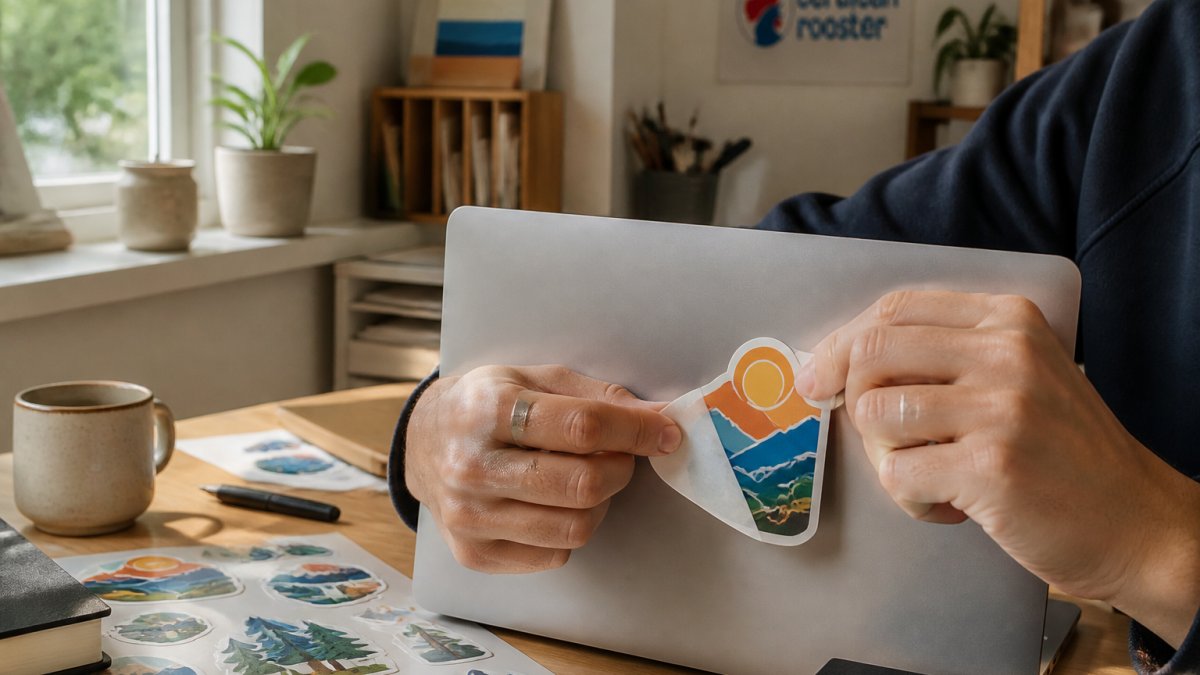
We've watched the sticker market fill up with lookalike shops selling the same clip-art cats and motivational quotes. So when people ask us what makes a sticker shop unique, we point to the things you can't copy: an artist's voice, a specific audience, and a customer experience built by hand.
Unique Handmade Stickers vs. Mass-Produced Options
The clearest difference between unique handmade stickers and mass-produced ones is intent. Mass-produced stickers are designed to appeal to the widest possible audience, which usually means generic imagery and safe color choices. Handmade stickers start with an artist's idea and end with something you won't see on a thousand other laptops.
Why Handmade Matters
Handmade means a person decided this design was worth making. That shows up in the details: linework with actual character, color palettes chosen on purpose, and imagery that carries a story. Our Four Seasons Sticker Bundle is a good example. Spring King, Summer Joker, Fall Jack, and Winter Queen are original hand-illustrated playing card characters. When you collect the full set, you're collecting a complete narrative.

Mass-produced options have their place. They're cheap and easy to reorder. But they can't give you a design that feels like it was made for you, because it wasn't.
How to Choose Quality Stickers for Your Needs
Choosing quality stickers comes down to four checks: face material, adhesive, laminate or finish, and cut type. A beautiful design on flimsy paper will peel, fade, or bubble within weeks. Get the physical specs right and the art actually lasts.
Material and Adhesive Checks
Start with the face material. Vinyl is the standard for anything that gets handled, washed, or left outdoors, because the film flexes with the surface instead of cracking and holds up to moisture and sunlight. Paper stickers are fine for journals, planners, and gift enclosures where they'll stay dry and flat.
Then check the adhesive. Permanent adhesive is the default for water bottles, laptops, and helmets, and it's meant to stay put. Removable adhesive is what you want for planners, bullet journals, and anywhere you might reposition the sticker later.
Finish matters too. A matte laminate softens glare and hides fingerprints. A gloss laminate makes colors pop and wipes clean easily. Either way, the laminate is what protects the printed ink from UV fading and from the scuffs that come with daily use.
Cut Type, Print Quality, and What to Ask
Cut type changes how a sticker behaves on a surface. A die-cut sticker is trimmed to the outline of the artwork, so there's no border and the shape follows the design.
Print quality matters just as much. Crisp lines and saturated color come from high-resolution printing, and you can usually judge it from close-up photos on the shop's product pages. If the shop only shows small, distant mockups, ask for a detail shot. Look for clean edges on fine linework and consistent color across the sheet, since banding and muddy gradients are the usual signs of a low-resolution print.
Here's a quick way to match the sticker to the job:
| Use Case | What to Look For | Why It Matters |
|---|---|---|
| Water bottles and tumblers | Vinyl face, permanent adhesive, gloss or matte laminate | Survives washing, condensation, and repeated handling |
| Laptops and phone cases | Die-cut vinyl, matte or gloss finish | Resists rubbing, heat, and pocket wear |
| Journals and planners | Vinyl or quality paper, removable adhesive, kiss-cut sheet | Lies flat, easy to reposition and layer |
| Gifts and cards | Coordinating art style, sturdy backing | Feels considered, not thrown together |
| Bike helmets and outdoor gear | Vinyl face, permanent adhesive, UV-resistant laminate | Handles sun exposure and weather |
If you're unsure, ask the shop directly. A small studio will usually tell you exactly what a sticker is made of and where it works best. The questions worth asking are simple: What's the face material? Is it die-cut? A shop that can answer those without hedging knows its own product.
Best Stickers for Water Bottles and Everyday Gear
The best stickers for water bottles are die-cut vinyl because they handle repeated washing and daily handling without curling at the edges.
Everyday gear is where stickers earn their keep. A laptop lid, a sketchbook cover, a phone case, a bike helmet: these are small surfaces that say something about you. Our It's Axe Time Vinyl Sticker brings dark fantasy energy to that space with black-and-white linework and a double-bladed axe design full of etched patterns and eye motifs. The Cerulean Rooster Die-Cut Vinyl Sticker takes the opposite approach, with crisp lines and vibrant blue tones built around our rooster mascot. Both are vinyl, both are made for the surfaces you actually use.

The Art Behind the Sticker: Original Designs That Tell a Story
Original design is the part of a sticker shop that can't be replicated, because it comes from a specific artist's hand and point of view. Two shops can sell stickers at the same size and price and feel completely different, and the artwork is why. This commitment to a singular aesthetic vision often bridges the gap between a simple stationery store and the broader world of curated lifestyle shops where every item reflects a cohesive narrative.
This is where the SERP-style guides tend to stop short. They cover printers, cutting machines, and sticker paper, which is useful if you're making stickers yourself. But they rarely explain why one shop's work sticks with you and another's doesn't. The answer is authorship. When an artist draws a character, the character has a history. When a shop licenses a generic image, it doesn't.
We think about this constantly. Every design we release starts as a drawing by one of us, and it carries a mood we chose on purpose, whether that's the fresh energy of the Spring King or the grim fantasy of a battle axe. That's the difference between a product and a piece of someone's imagination.
Customer Experience: The Personal Touch That Sets Shops Apart
Customer experience is often the deciding factor between two shops with equally good stickers. Ordering from a small studio should feel different from checking out at a big-box store, and the details are where that shows up. Most guides on sticker shops skip this part entirely. They cover printers, cutting machines, and sticker paper, which is useful if you're making stickers yourself, but they rarely explain why one shop's work sticks with you and another's doesn't.
What Actually Shows Up in the Mail
Packaging is the first place a small studio can separate itself. A hand-packed order usually means the sticker is protected with a rigid backing or a sleeve, the envelope is sealed by a person rather than a machine, and there's often a small extra. None of that is expensive, but it signals that someone handled your order on purpose.
For us, packing is personal by default. Every order is packed by hand in our small studio, so the person sealing your envelope is one of the two brothers who drew the art inside it. That's not a marketing line. It's just how a family-run studio operates. It also means if something goes wrong with your order, you're talking to the people who made it, not a support queue.
Community, Ownership, and Who You're Supporting
Conscious buyers also ask who they're supporting. Ours is a deaf-owned, family-run business, and that's part of what you're choosing when you order. Expressive art is how we communicate, and that shapes the work itself, not just the packaging. When you buy from a shop like ours, you're supporting a specific point of view rather than an anonymous print operation.
Originality and ownership matter here too. A shop that draws its own art can tell you where a design came from, who made it, and what it means. A shop that licenses generic images usually can't. That difference shows up in how a shop talks about its work, how consistent its catalog feels, and whether the artist is visible or hidden behind a brand name.
A few things worth checking before you buy from any shop:
- Can you see who makes the art, or is the shop anonymous?
- Are product photos close enough to judge print quality?
- Does the shop explain its materials and where stickers work best?
- Is there a clear way to reach a real person if you have an issue?
- Does the shop's overall style feel consistent across its catalog?
- Does the shop say where its designs come from and who owns them?
Why This Is the Hardest Thing to Copy
A competitor can match your sticker size, your vinyl, and your laminate. What they can't easily match is the relationship between the artist, the audience, and the way an order arrives. That's why the shops people remember tend to be the ones with a visible maker, a consistent visual voice, and a buying experience that feels like it came from a person rather than a warehouse.
Conclusion: Finding a Sticker Shop That Feels Like Yours
The challenge with a crowded sticker market is that everything starts to look the same after a while. The fix is to look past the catalog and ask who's behind it: whose art it is, who packs the envelope, and whether the shop stands for anything beyond moving units.
That's the whole idea behind Cerulean Rooster. We're two deaf brothers making original art and stickers by hand, with designs that feel human and expressive, and every order packed personally in our studio. If you want stickers that carry a story instead of a trend, browse our shop and find the one that feels like yours.
Frequently Asked Questions
What makes a sticker shop unique?
A sticker shop stands out through its artistic point of view, the story behind its designs, and how it treats customers. Original artwork, hand-illustrated characters, and a clear brand identity matter more than sheer volume. Shops that share their process, pack orders by hand, and build a community around their art create a connection that mass-produced sellers cannot copy.
Why do people choose unique handmade stickers over cheaper alternatives?
Handmade stickers carry the artist's personality. Each design is drawn by a person, not pulled from a template library. Buyers often want something that reflects who they are, and a handmade sticker does that in a way a generic pack cannot. The durability of quality vinyl also means the artwork lasts on water bottles, laptops, and notebooks.
What should I look for when choosing quality stickers?
Check the material first. Vinyl stickers resist water, UV light, and scratching. Look at the print resolution: crisp lines and vibrant colors signal a high-quality print. Ask about the adhesive if you plan to stick them on water bottles or outdoor gear.
Are vinyl stickers good for water bottles?
Vinyl is one of the best materials for water bottles because it handles moisture, temperature changes, and daily handling. Die-cut vinyl stickers with a strong adhesive stay put through washing and refilling. For best results, apply the sticker to a clean, dry surface and press firmly from the center outward to avoid bubbles.