
Send Personalized Greeting Cards: Step-by-Step Guide
Mitchell AdelmanTable of Contents
- Choose Your Personalized Greeting Card Format and Design
- What to Write in a Greeting Card
- Greeting Card Message Examples for Every Occasion
- How to Address a Greeting Card Properly
- Proof Your Card Before Mailing
- Mailing Greeting Cards: Postage, Packaging, and Timing
- Frequently Asked Questions
Last Updated: October 14, 2026
Choose Your Personalized Greeting Card Format and Design
Sending a personalized greeting card is one of the most meaningful ways to connect, it carries your voice, your taste, and your effort.
Pick an Occasion or Holiday
The occasion shapes everything about your personalized card. A birthday, thank you, anniversary, or sympathy note each calls for a different tone and design.
Celebrations call for uplifting colors, gratitude for something warm, sympathy for something calm and respectful. Let the occasion guide your design.
Select a Design That Feels Right
This is where your card becomes truly personal, you're picking a design that represents how you feel about the recipient.
Look for designs that resonate:
- Does the artwork match the person's personality?
- Do the colors fit the occasion?
- Does the vibe match your relationship?
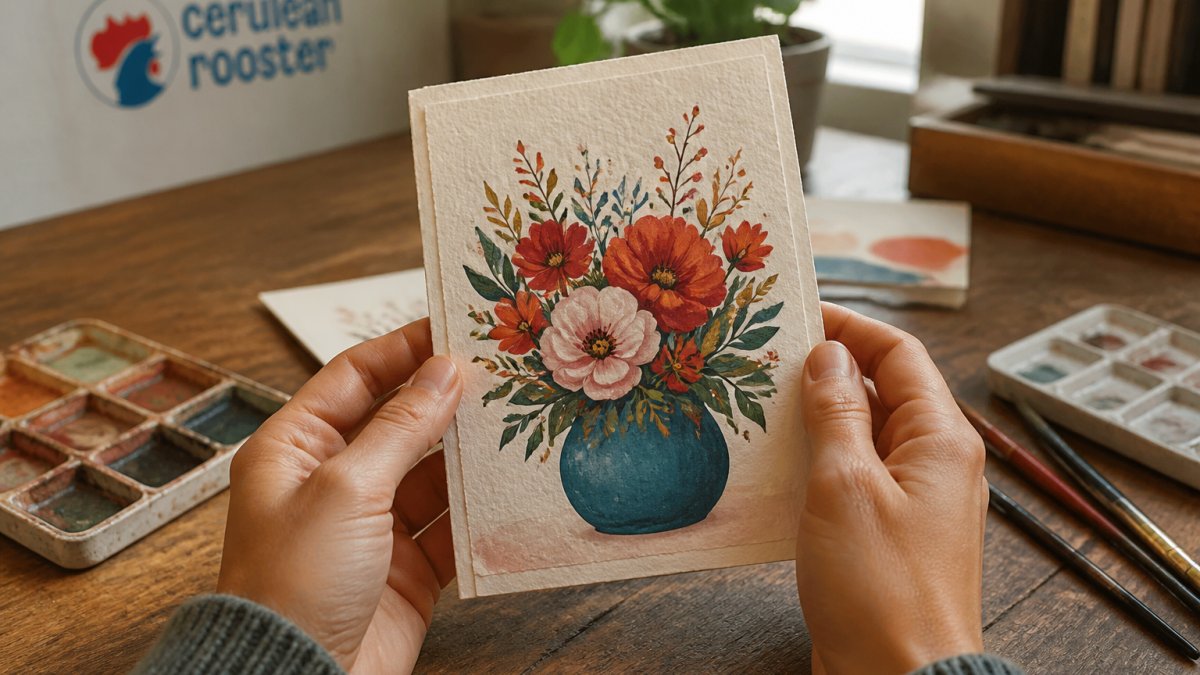
Our handmade cards at Cerulean Rooster feature original artwork created by two brothers, each made with intention. Genuine, expressive art means more than something mass-produced, and your card may sit on someone's shelf or in their memory box for years.

What to Write in a Greeting Card
Writing a greeting card message can feel intimidating, but the best messages are honest, specific, and brief. You don't need flowery language, you need your voice.
Start With Authenticity
The most powerful messages feel like they came from a real person, not a greeting card factory. Write like you speak, with words you actually use, funny if you're funny, sincere if you're sincere.
Think about what you genuinely want to communicate, celebrating an achievement, thanking someone, offering support, and let that intention guide your words.
A good opening line:
- Names the occasion or feeling directly
- Feels personal to that specific person
- Sets the tone for the rest of the message
Match Your Tone to the Occasion
Your tone should match the occasion and your relationship with the person, a birthday card to your best friend sounds different from one to your boss.
Decide on your tone, funny or serious, formal or casual, heartfelt or lighthearted, then stick with it. Don't mix a jokey opening with a serious closing; keep it consistent.
Greeting Card Message Examples for Every Occasion
Real examples help more than generic advice. Use these as starting points for your own personalized greeting card.
Birthday and Celebration Messages
For a friend's birthday: "Happy birthday to someone who makes life more fun just by showing up.
For a milestone birthday: "You've earned every single one of these years.
For a promotion or achievement: "I knew this was coming.
For a new job: "New chapter, same you, just in a different office.
Thank You and Gratitude Messages
For someone who helped during a tough time: "I want you to know that what you did mattered.
For a general thank you: "You made a real difference.
For a mentor or teacher: "You believed in me when I wasn't sure I believed in myself.
Our Thank You Jar Card from Cerulean Rooster captures this gratitude perfectly.

Sympathy and Support Messages
For the loss of a loved one: "I'm thinking of you during this difficult time.
For someone going through a hard time: "I know things are rough right now.
For a health challenge: "You're stronger than you know. I'm rooting for you and thinking of you every day.
How to Address a Greeting Card Properly
An addressed envelope matters, it's the first thing the recipient sees, and a thoughtful one shows you cared about every detail of this personalized greeting card. But addressing is where most cards quietly fail: a missing apartment number or a stale address can send your card into a mail-forwarding void or back to your own mailbox weeks later.
Gather and Verify Recipient Information
Before you address anything, collect the full set of details:
- Full name as the recipient uses it (confirm spelling, especially for names with apostrophes, hyphens, or accents)
- Complete mailing address, including directional prefixes (N, S, E, W) and street suffixes (St, Ave, Blvd, Rd, Ln)
- Apartment, unit, suite, or floor number if applicable
Then verify it:
- Confirm the ZIP code. The USPS ZIP Code Lookup tool returns the correct city, state, and ZIP, plus ZIP+4 when available.
- Ask the recipient directly if you're unsure. A quick text beats a guess.
- Watch for recent moves. If someone relocated in the last year, their old address may still be in your contacts.
Write the Address Clearly
Use a pen that won't smudge, a fine-tip permanent marker or ballpoint works well.
Standard format for addressing an envelope:
- Line 1: Recipient's name
- Line 2: Street address (with apartment or unit number)
- Line 3: City, state, ZIP code
Center the address block and leave space around it. Avoid the corners, that's where postal markings, barcodes, and postage go.
If you're sending to an apartment or office:
- Jane Smith
- 456 Oak Street, Apt 3B
- Portland, OR 97201
Include your own return address in the upper-left corner. If the card can't be delivered, a return address is what brings it back to you instead of into the dead-letter stream.
Manage Recipient Lists and Privacy
If you're sending personalized greeting cards to more than one person, you're managing a small mailing list. A few habits keep it clean and safe:

- Keep addresses in one place. A spreadsheet or notes app entry per person beats scattered texts and screenshots. Include the date you last confirmed each address.
- Don't share the list. Keep it face-down or on your own device in public, a stray photo can expose dozens of people at once.
- Avoid group texts for address collection. Ask individually or use a private form; a group thread exposes everyone's address to everyone else.
Handle Special Address Situations
A few scenarios need extra care:
- International recipients: Format with the recipient's name, street, city, and postal code, then the destination country in capitals on its own line. Confirm the country's conventions, some place the postal code before the city.
- Business addresses: Put the company name on its own line above the recipient's name, and the suite or floor number with the street address.
- PO boxes: Use "PO Box" followed by the number. Don't combine a PO box with a street address on the same line.
A correctly addressed envelope is quiet work, but it's the difference between a card that arrives and one that never does.
Proof Your Card Before Mailing
Before you seal that envelope, review your personalized greeting card. This is your chance to catch mistakes, and it's the step most people skip. Proofing isn't just about spelling; it's about whether the card works for the person receiving it.
Proof the Message
Read your message the way the recipient will: top to bottom, once, without stopping to fix anything. Then check:
- Is it legible? No smudges, crossed-out words, or ink that bled through.
- Did you spell the recipient's name correctly? This is the most common and most noticed error. Check it letter by letter.
- Does it make sense from start to finish? Read it out loud, if you stumble, the recipient will too.
Read it once more out loud. Does it sound like you? If something feels off, rewrite it on a new card, a rushed handwritten personalized greeting card will show. Take the extra five minutes to get it right.
Proof the Artwork and Design
If your card features printed artwork, a portrait, a pet illustration, a custom design, proof the image itself, not just the words:
- Resolution: Printed images need enough pixels to look sharp. A photo that looks fine on a phone can look soft or pixelated at card size, use the highest-resolution version you have.
- Cropping: Check that nothing important is cut off at the edges. Faces, pet ears, and text near the border are the usual casualties.
- Color: Screens and printers render color differently, a deep red on your monitor may print closer to brick. If accuracy matters, ask for a proof or order a single test card first.
Run an Accessibility Check
A card that's beautiful but hard to read isn't doing its job. A few quick checks make it work for more people:
- Type size: If you're printing text rather than handwriting it, keep it large enough to read without squinting. Small decorative fonts look elegant but can be difficult for older recipients or anyone with low vision.
- Contrast: Dark ink on a light card, or light ink on a dark card. Avoid mid-tone on mid-tone.
- Font choice: Stylized scripts are charming for a name or short greeting but exhausting for a full paragraph. Use them sparingly.
Preview Digitally Before You Commit
If you're ordering a printed card or designing one on a screen, preview it before you finalize:
- View it at actual size. Zoom out until the card is roughly the size it will be in hand. Does the message still read comfortably?
- Check it on a phone. Most people see a digital preview on a small screen first. If it's hard to read there, it'll be hard in print too.
- Look at it in grayscale. This catches contrast problems that color can hide.
A carefully proofed card feels different to the person holding it: the details are right, the message lands, and the artwork looks the way you intended. That's the difference between a card that gets displayed and one that gets recycled.
Mailing Greeting Cards: Postage, Packaging, and Timing
Getting your personalized greeting card into the mail safely and on time matters. The logistics are simple but deserve attention.
Choose Your Mailing Method
You have two main options: standard mail, which typically takes 3-5 business days, or priority mail, which takes 1-3. Standard mail is fine for most occasions; for time-sensitive events, priority mail is worth it.
Consider packaging too. A standard envelope works for most cards, but for a special card or one with delicate artwork, a rigid mailer protects it during shipping and shows the recipient you cared enough to send it safely.
Plan Your Timeline
Timing is everything. A birthday card should arrive on or before the birthday; a sympathy card should arrive sooner rather than later.
A realistic timeline:
- Write and address the card: 15-30 minutes
- Let handwritten ink dry: 5-10 minutes
- Get to the post office: varies
Plan backward from the arrival date.
Sending a personalized greeting card is a small act that carries real weight. When you choose one of our personalized greeting cards, you're choosing something that reflects real artistry and intention.
Frequently Asked Questions
How do I personalize a greeting card to make it feel truly thoughtful?
Personalization goes beyond adding a name. Reference a specific memory, inside joke, or shared experience with the recipient. Mention something they've recently accomplished or a quality you admire. Handwriting your message adds genuine warmth that printed text can't match. The most meaningful personalized cards connect emotionally, they show you've taken time to think about what matters to that person.
What should you write inside a greeting card if you're not sure what to say?
Start with honesty. Say why you're sending the card: 'I wanted you to know I'm thinking of you' or 'Your kindness meant so much to me.' Keep it short, three or four sentences often feels more genuine than a long paragraph. Use your own voice, not flowery language that doesn't sound like you. Even 'I'm not great with words, but I care about you' is more meaningful than generic phrases.
How long does it take to mail a greeting card after I order?
Standard greeting card mailing typically takes 3-5 business days with regular first-class mail, depending on distance. Plan ahead for holidays and special occasions, mail volume increases during peak seasons. Handmade cards are worth the wait when possible.
Can I order a custom or hand-illustrated greeting card if I need something unique?
Yes, Cerulean Rooster offers custom commissions. You can request personalized illustrations, specific colors, or designs that match your vision. Custom work takes longer than ready-made cards. Provide clear details about what you want, reference images, color preferences, and the occasion help artists create something that feels authentically yours.