
How to Tell If Stickers Are Waterproof: A 2026 Guide
Mitchell AdelmanTable of Contents
- What Makes a Sticker Waterproof
- How to Test If a Sticker Is Waterproof
- Waterproof vs. Water-Resistant Stickers: What's the Real Difference
- Are Vinyl Stickers Waterproof
- How Long Do Waterproof Stickers Last in Water
- Reading Labels and Interpreting Waterproof Claims
- Common Mistakes When Testing Sticker Durability
- Frequently Asked Questions
Last Updated: October 6, 2026
What Makes a Sticker Waterproof
How to tell if stickers are waterproof comes down to three layers: material, ink, and protective coating. At Cerulean Rooster, we craft vinyl stickers with these principles in mind, built for water bottles, laptops, and outdoor gear.

Understanding how to tell if stickers are waterproof isn't one thing, it's layers working together. Skip one, and water finds a way in.
Material: Vinyl vs. Paper
Vinyl stickers are plastic-based and resist moisture. Paper absorbs water and deteriorates fast.
- Vinyl stays intact when wet, costs more upfront, lasts years outdoors
- Paper curls, bubbles, and falls apart, fine for indoor journals and notebooks
To know if a sticker is waterproof, first check what it's made from. Vinyl feels plastic-like; paper feels like cardstock.
Ink and Protective Coatings
Even vinyl stickers fail if the ink isn't waterproof, standard inks wash away or fade.
Waterproof inks bond with vinyl without bleeding or smudging. Many quality vinyl stickers also have a laminate layer that seals the ink, protects against scratches and UV, and extends outdoor lifespan.
Ask yourself: Is this vinyl? Does it have a protective layer? If both are yes, it's likely truly waterproof.
How to Test If a Sticker Is Waterproof
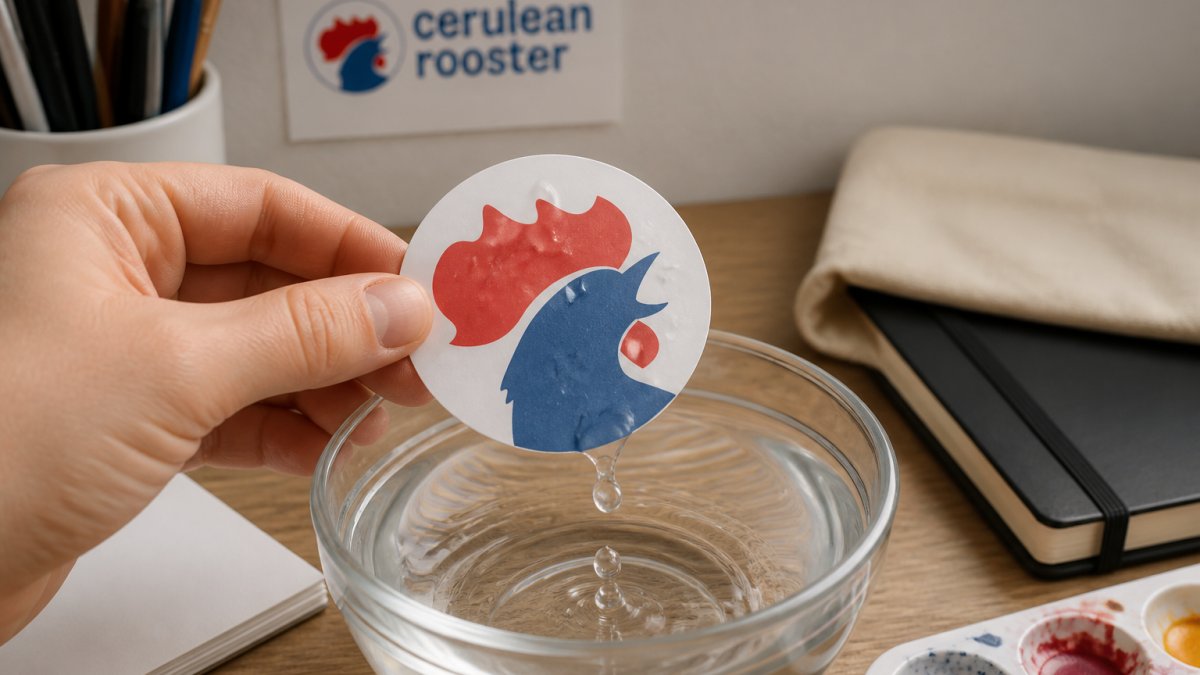
Most guides tell you what a waterproof sticker is, few show you how to test one you own. These four checks take about fifteen minutes, use room-temperature tap water, and each tests a different layer.
Test 1: The Damp-Cloth Wipe (Ink Check)
The fastest way to check whether the ink is waterproof or just the vinyl underneath.
- Dampen a clean white paper towel or cotton cloth with room-temperature tap water, damp, not dripping.
- Wipe firmly across the printed area five times in one direction.
- Look at the cloth.
- No color, design crisp, ink is sealed or water-resistant.
- Faint color, design duller, water-resistant but not waterproof; it'll fade over months.
- Obvious color transfer, soft edges, not waterproof; it'll smear when truly wet.
This isolates the ink, a sticker can pass the droplet test and still fail here.
Test 2: The 30-Second Droplet Test (Surface Check)
Place three or four drops of room-temperature water on the printed area and start a timer.
- At 30 seconds: drops should sit on top as distinct beads.
- At 2 minutes: tilt the sticker, drops should roll off and leave the surface dry.
If water spreads into a flat film or the surface darkens, the top layer is absorbing moisture, usually no laminate or water-repellent coating.
Test 3: The 10-Minute Soak (Material and Edge Check)
This separates "survives a splash" from "survives a water bottle."
- Fill a glass with room-temperature tap water.
- Submerge the sticker completely (peel any paper backing first).
- Leave 10 minutes without stirring.
- Remove, lay printed-side up on a dry plate, and air-dry one hour.
Check five things after drying:
- Edges: flat or curled? Curling means water got under the edge.
- Colors: same or washed out? Fading means the ink absorbed water.
- Surface: smooth or bubbled? Bubbling means the vinyl took on water.
Pass all five and it's genuinely waterproof for short-term immersion. Pass two or three and it's water-resistant, fine for a laptop lid, risky for a bottle.
Test 4: The Edge-Lift Check (Adhesive Check)
Water almost always gets in at the edge first. This tests how the adhesive behaves on your actual surface.
- Apply the sticker to a clean, dry sample of the real surface, a spare bottle, tile, or painted metal. Press firmly from the center outward.
- Wait 24 hours for the adhesive to bond.
- Run it under a faucet 30 seconds, or dunk it one minute.
- Dry it and immediately try to lift a corner with a fingernail.
- Corner resists, snaps back, adhesive is holding.
- Corner lifts easily and stays lifted, water compromised the bond, and it'll only get worse on curved or textured surfaces.
A sticker that holds on a flat laptop lid can lift within a week on a curved, textured bottle.
What These Tests Can't Tell You
None of these tests simulate the dishwasher, saltwater, or long-term UV. A sticker that passes all four can still fail after a summer on a car window. Treat a pass as "waterproof for normal hand-washing and rain," not "indestructible." For dishwasher or marine-level durability, buy a sticker rated for it, and test that claim the same way.
Waterproof vs. Water-Resistant Stickers: What's the Real Difference
These terms get used interchangeably, but they mean different things.
Water-resistant stickers handle light moisture, splashes, brief rain, and condensation, but not constant submersion or saltwater.
Waterproof stickers handle prolonged exposure, saltwater, submersion, and harsh outdoor conditions, lasting years on bottles, boats, or gear.
A water-resistant sticker on a bottle might last a few months; a waterproof one can last years.
Are Vinyl Stickers Waterproof
Not all vinyl stickers are equally waterproof. Vinyl resists water, but that doesn't guarantee the sticker survives exposure:
- The material resists water, but the ink might not
- The adhesive might weaken when wet
- The edges can peel if not sealed
A vinyl sticker is waterproof only when material, ink, and protective coating all work together.
PVC and Vinyl Construction
Most quality vinyl stickers use PVC (polyvinyl chloride) or similar compounds, inherently water-resistant because they're plastic.
What makes the difference:
- Thickness (thicker = more durable)
- Adhesive quality (permanent holds better when wet)
- Ink formulation (waterproof inks don't fade or bleed)
Thin vinyl (2-3 mil) is cheaper but less durable. Thicker vinyl (4-5 mil or more) resists water better and lasts longer outdoors.
Lamination and Protective Coatings
The real secret to waterproof vinyl stickers is often the protective coating on top.
A laminate layer:
- Seals the ink so colors don't fade
- Protects against scratches and UV
- Prevents water from seeping into the edges
Look for a glossy or matte finish that feels smooth and sealed, that's usually laminate at work. Unlaminated stickers won't hold up to years outdoors.
How Long Do Waterproof Stickers Last in Water
A truly waterproof sticker can last years, but "years" depends on conditions. Indoors, a bottle kept inside, a laptop sticker in a bag, expect 3-5 years or longer with strong adhesive. Saltwater, constant sun, and temperature swings wear stickers down faster.
Water Bottle and Outdoor Use
A waterproof sticker on a regularly washed and refilled bottle can last 1-2 years before showing wear.
What affects durability:
- Hot water degrades adhesive faster than cold
- Dishwasher heat can peel stickers within months
- Rubbing during washing wears the edges
To make a sticker last on a bottle: hand wash, avoid boiling water, and keep it out of direct sunlight when possible.
Saltwater, UV, and Extreme Conditions
Saltwater is brutal, salt crystals form as water evaporates and lift the sticker's edges, while UV fades colors and degrades vinyl.
In saltwater environments (boats, beach gear), expect 6-12 months before noticeable fading or peeling. In extreme heat or constant sun, 1-2 years.
For maximum durability:
- Choose UV-protective coatings
- Look for vinyl rated for marine or outdoor use
- Test in your actual conditions before applying permanently
Reading Labels and Interpreting Waterproof Claims
Sticker listings use a small vocabulary of phrases, each telling you something different about what was tested. Here's how to decode them.
What Each Claim Actually Proves
| Label wording | What it tells you | What it does NOT tell you |
|---|---|---|
| "Vinyl sticker" | The face material is plastic-based and won't absorb water like paper | Nothing about the ink, coating, or adhesive |
| "Water-resistant" | Survives splashes, condensation, and brief rain | Not rated for submersion, dishwashing, or saltwater |
| "Waterproof vinyl" | The vinyl itself resists water penetration | Ink may still smear; adhesive may still lift |
| "Waterproof ink" | The printed design won't bleed or fade when wet | The sticker face or adhesive may still fail |
| "Laminated" or "sealed" | A clear film or coating covers the print | Doesn't confirm the adhesive is water-resistant |
| "UV-resistant" or "UV-protected" | Colors are formulated or coated to resist sun fading | Says nothing about water performance |
| "Permanent adhesive" | The bond is meant to be long-term | Doesn't guarantee the bond survives water |
| "Dishwasher safe" | Tested against hot water and detergent | Rare on stickers; treat with skepticism unless specified |
A sticker is only fully waterproof when the listing addresses all four layers: material, ink, coating, and adhesive. If one is missing, assume it's the weak point.
The Wording That Should Make You Pause
- "Waterproof" with no qualifier. Waterproof under what conditions? A rainstorm and a dishwasher are different products. If the listing doesn't say, ask.
- "Durable" or "long-lasting." Marketing words, not test results.
- A price far below comparable vinyl stickers. Waterproof ink and laminate cost more, so a suspiciously low price usually means a layer was skipped.
Questions Worth Asking Before You Buy
If you're buying from a small maker, including us, a short message gets a real answer. Ask:
- What kind of vinyl is this, and how thick?
- Is the ink waterproof, or is the vinyl just water-resistant?
- Is there a laminate or clear coating over the print?
- What adhesive is used, and how does it hold on curved or textured surfaces?
- Has this been tested in a dishwasher, saltwater, or direct sun?
A maker who knows their materials answers all five. One who just says "yes, it's waterproof" is guessing.
How We Approach It
We're two deaf brothers who make every sticker, card, and portrait by hand, and we treat material choices as deliberately as the artwork. When we say water-resistant, we mean it handles condensation, rain, and hand-washing. When we say waterproof, we mean the ink, laminate, and adhesive were all chosen to work together.
Common Mistakes When Testing Sticker Durability
Many people test stickers wrong and draw the wrong conclusions. Avoid these pitfalls.
Mistake 1: Testing in fresh water only Fresh water and saltwater behave differently.
Mistake 2: Not waiting long enough Some stickers soak up water slowly.
Mistake 4: Applying to wet surfaces Even waterproof stickers won't stick well to wet surfaces.
Choosing the right sticker for water exposure comes down to understanding what "waterproof" actually means and testing before you commit. Our handmade vinyl stickers are crafted with durability in mind, designed to bring expressive art into your everyday life, on a water bottle heading to the gym or a laptop that travels everywhere. Shop All and find stickers as thoughtful and lasting as the designs themselves.

Frequently Asked Questions
How can you tell if a sticker is waterproof without testing it?
Check the product description for materials like vinyl, PVC, or lamination. Vinyl stickers with protective coatings are almost always waterproof. Look for seller claims about water resistance and read customer reviews mentioning water exposure. At Cerulean Rooster, our vinyl stickers are designed with durability in mind, each piece is crafted to handle real-world use on water bottles, laptops, and outdoor gear.
What's the difference between waterproof and water-resistant stickers?
Waterproof stickers can handle full submersion and prolonged water contact without damage. Water-resistant stickers resist splashes and light moisture but may degrade with extended water exposure. Vinyl stickers with lamination are typically waterproof, while paper stickers are usually just water-resistant. If your sticker will live on a water bottle or outdoor surface, waterproof is the safer choice.
Are all vinyl stickers waterproof?
Most vinyl stickers are water-resistant or waterproof, especially when printed with quality inks and protective coatings. However, the adhesive underneath matters too, it must stick to wet surfaces. Not every vinyl sticker is created equal. Our vinyl stickers at Cerulean Rooster are engineered for durability, making them suitable for water bottles, vehicles, and outdoor display without fading or peeling.
How long do waterproof stickers actually last on a water bottle?
High-quality vinyl stickers with lamination can last 2-4 years on a water bottle with regular use and washing. Dishwasher exposure shortens lifespan to 6-12 months. Saltwater and direct sunlight accelerate fading. The adhesive fails before the material does in most cases. Test conditions matter, gentle hand washing extends life far longer than aggressive scrubbing or heat exposure.