
How to Spot High Quality Stickers: A 2026 Guide
Mitchell AdelmanTable of Contents
- What Makes a Sticker High Quality
- Check the Vinyl Material and Composition
- Examine Print Resolution and DPI Standards
- Assess Adhesive Strength and Backing Types
- How to Tell If a Sticker Is Waterproof
- Matte vs Glossy Vinyl Stickers: Which Lasts Longer
- Best Handmade Stickers for Water Bottles 2026
- Tactile Quality Testing and Adhesive Residue Analysis
Last Updated: August 27, 2026
What Makes a Sticker High Quality
High quality stickers are built on three foundations: durable materials, precise printing, and reliable adhesion. At Cerulean Rooster, we've spent years perfecting the craft of handmade stickers, and we've learned that quality isn't just about how a sticker looks, it's about how it performs over time.

The difference between a sticker that lasts six months and one that lasts two years comes down to the vinyl material, the adhesive backing, and the printing resolution. A truly high quality sticker resists fading, peeling, and cracking. It adheres cleanly without leaving residue. And it maintains its vibrant colors whether it's stuck on a water bottle in direct sunlight or tucked inside a journal.
Most people assume all vinyl stickers are created equal. They're not. The vinyl composition, lamination thickness, print DPI, and adhesive type all determine whether your sticker becomes a cherished keepsake or a flaking disappointment.
Check the Vinyl Material and Composition
Vinyl comes in two main types: calendered and cast. Calendered vinyl is thinner, more affordable, and works well for flat surfaces. Cast vinyl is thicker, more flexible, and better for curved surfaces like water bottles and car windows. For handmade stickers that need to last, cast vinyl is the superior choice, it conforms to contours without cracking.
The material thickness matters too. Quality vinyl stickers typically measure between 2 and 5 millimeters thick (astm.org). Thinner vinyl (under 2mm) becomes brittle over time, especially in sunlight. Thicker vinyl (over 5mm) can feel cheap and plasticky. The sweet spot is around 3-4 millimeters, which provides durability without excess bulk.
When you're evaluating high quality stickers, run your thumb across the surface. Does it feel smooth and uniform? Or does it have thin spots, bumps, or inconsistent texture? Premium vinyl has a consistent, refined feel. Budget vinyl often feels waxy or cheap to the touch.
One detail most people miss: check the edges. On high quality stickers, the vinyl edges are sealed cleanly. On cheaper stickers, edges are rough, frayed, or uneven. This edge quality is a dead giveaway of manufacturing precision.
Examine Print Resolution and DPI Standards
Print resolution determines whether your sticker looks crisp or pixelated. Resolution is measured in DPI, dots per inch. High quality stickers are printed at 300 DPI minimum. Anything below 240 DPI will show visible pixelation, especially on detailed designs or small text.
The difference between 300 DPI and 600 DPI is subtle to the eye but matters for fine details. If your sticker design includes thin lines, small text, or intricate shading, 600 DPI ensures clarity. For bold, simple designs, 300 DPI is sufficient.
Ask the printer or creator what DPI they use. If they can't answer or claim their stickers are "high quality" without specifying DPI, that's a red flag. Transparency about print specs signals professional standards.
Vector files produce sharper stickers than raster files. Vector designs are built from mathematical paths, so they scale perfectly without quality loss. Raster images (like JPEGs) are made of pixels and degrade when enlarged. If you're commissioning custom stickers, always provide vector files or ask the designer to convert your artwork to vector format before printing.
Color accuracy depends on CMYK color mode, not RGB. RGB is for screens; CMYK is for print. High quality sticker printers work in CMYK to ensure colors match your expectations. If a designer hands you RGB files for print, they're cutting corners.
Assess Adhesive Strength and Backing Types
The adhesive is where most cheap stickers fail. Quality stickers use permanent or semi-permanent adhesive that bonds instantly and holds for years. Cheap stickers use temporary adhesive that peels off after weeks.
Adhesive strength is measured by peel strength, how much force is needed to remove the sticker without tearing (astm.org). High quality stickers have high peel strength, meaning they resist accidental peeling but still remove cleanly when you want them to. Low peel strength stickers slide off on their own.
The backing paper also matters. Premium stickers use release-coated backing that peels away smoothly without tearing or leaving adhesive residue. Budget stickers often use thin, cheap backing that tears during application or leaves sticky residue behind.
When you peel a high quality sticker, it should separate from the backing cleanly in one motion. If pieces of backing stick to the adhesive, or if the adhesive stretches and tears, that's a sign of inferior materials.
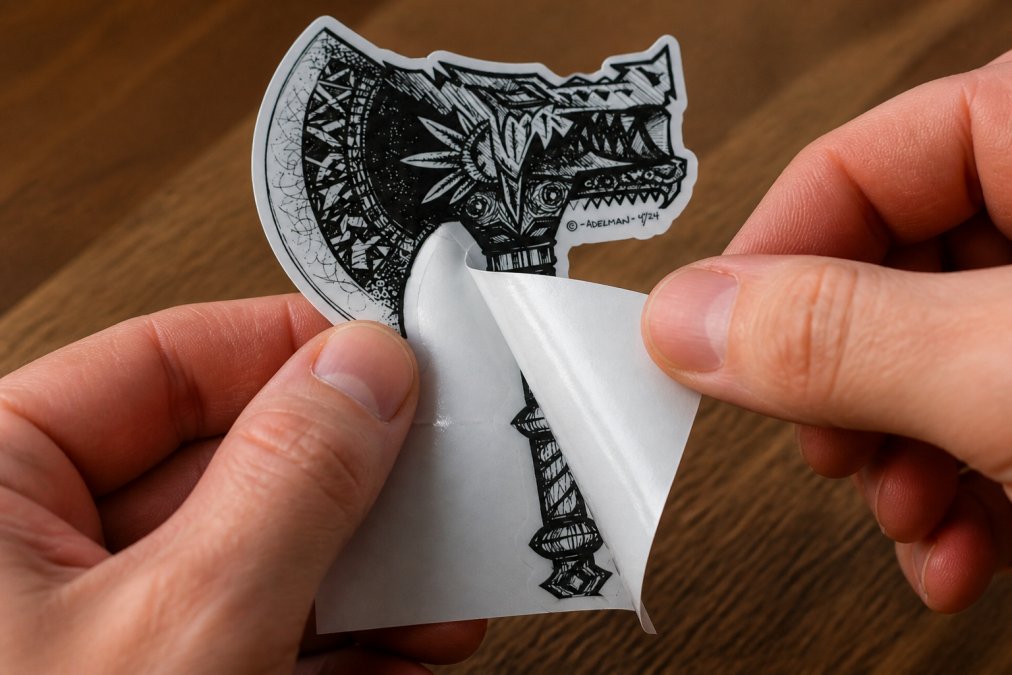
Test adhesive residue by applying a sticker to glass, waiting 24 hours, then peeling it off. High quality stickers leave no residue. Budget stickers leave a sticky film that requires rubbing with alcohol or vinegar to clean. That residue is a deal-breaker for water bottles and surfaces where appearance matters.
Cerulean Rooster stickers use permanent adhesive designed for outdoor durability. Each sticker is hand-packed in our studio to ensure the backing stays intact and the adhesive remains protected until you're ready to apply it.
How to Tell If a Sticker Is Waterproof
Waterproof and water-resistant are not the same thing. Water-resistant stickers repel light moisture but can fail under prolonged water exposure. Waterproof stickers survive full submersion, rain, and constant moisture without peeling or fading (iso.org).
High quality stickers are waterproof, not just water-resistant. This means the vinyl material itself is non-porous, the adhesive is moisture-resistant, and the lamination seals everything against water penetration.
Lamination is critical for waterproofing. A laminate layer sits on top of the printed design and protects it from UV rays, moisture, and scratches. Matte lamination provides a subtle finish; gloss lamination adds shine and extra protection. Both are waterproof when applied correctly.
To test waterproofness, apply a sticker to a water bottle, submerge it in water for 30 minutes, and inspect for bubbling, peeling, or color bleeding. High quality stickers show no damage. Budget stickers often bubble, peel at the edges, or show color fading.
The adhesive must also be waterproof. Some adhesives dissolve or weaken in water. Premium adhesives maintain their bond even after weeks of water exposure. This is why stickers from quality makers hold up on water bottles while cheap stickers slide off after a few washes. high quality prints.
Matte vs Glossy Vinyl Stickers: Which Lasts Longer
Matte and gloss finishes affect both appearance and durability. Matte vinyl has a non-reflective, soft finish that hides fingerprints and dust. Gloss vinyl is shiny and reflective, showing every smudge and fingerprint but appearing more vibrant.
For durability, both matte and gloss vinyl perform equally well if the underlying material and lamination are high quality. The difference is aesthetic and practical. Matte stickers are better for detailed designs where you want to see fine lines without glare. Gloss stickers are better for bold, colorful designs where you want maximum color pop.
Matte finishes show scratches more easily because the texture catches light differently at each scratch point. Gloss finishes hide minor scratches better because the reflective surface masks imperfections. For high-traffic surfaces like water bottles, gloss may age better visually.
UV resistance is where lamination shines. Both matte and gloss laminates protect against fading, but gloss lamination typically offers slightly better UV protection because the reflective surface bounces some UV rays away. For outdoor stickers exposed to constant sunlight, gloss-laminated vinyl will maintain color vibrancy longer.
The best choice depends on your use case. For water bottles that get handled frequently, matte vinyl hides fingerprints better. For laptop stickers that need to look sharp under office lighting, gloss vinyl pops more. For outdoor gear exposed to intense sun, either works, just ensure it's laminated and from a quality maker.
Best Handmade Stickers for Water Bottles 2026
Handmade stickers carry personality that mass-produced designs can't match. When you buy from a small creator like Cerulean Rooster, you're getting original art designed by real artists, not generic templates churned out by factories.
The best handmade stickers for water bottles combine three qualities: original design, durable materials, and thoughtful execution. Original design means the artwork is created specifically for sticker format, not adapted from something else. Durable materials mean cast vinyl, permanent adhesive, and waterproof lamination. Thoughtful execution means clean die-cuts, consistent color, and hand-packed quality control.
Our Cerulean Rooster stickers are die-cut to follow the exact outline of the artwork, creating a custom shape that fits the design perfectly. This attention to detail is what separates handmade stickers from standard rectangular stickers. Each design is hand-illustrated by our deaf artist co-founder, bringing expressive linework and unique character to every piece.
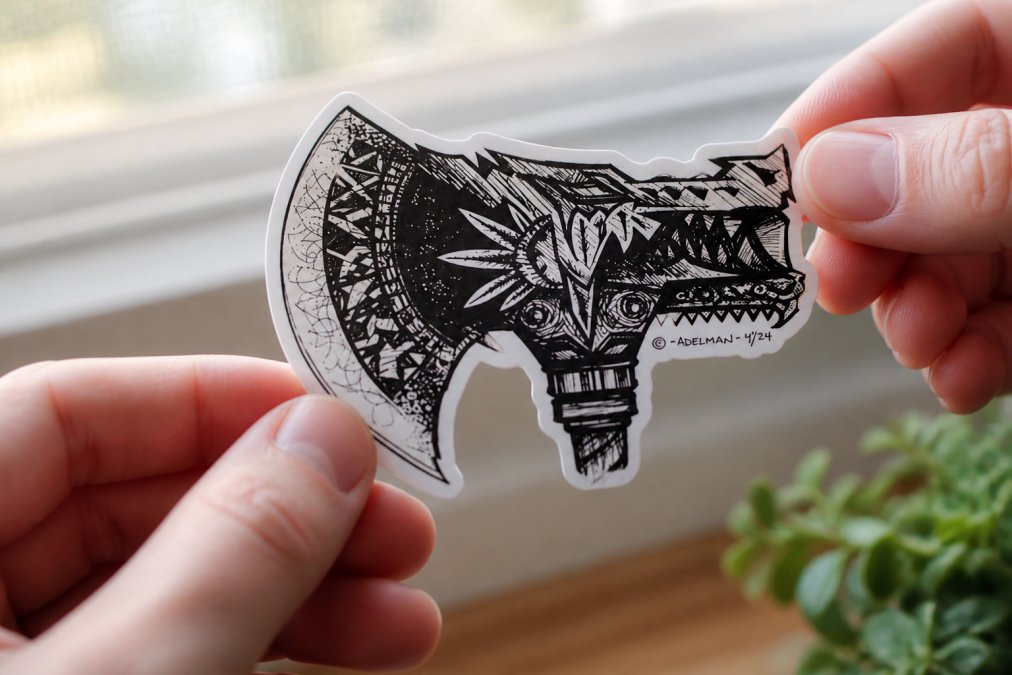
Consider the It's Axe Time Vinyl Sticker for bold fantasy fans, it features intricate black-and-white linework of a battle axe with ominous eye motifs, rendered with the kind of detail you only get from handmade illustration. Or the Menacing Astronaut Vinyl Sticker, which combines cosmic intensity with crisp line work perfect for sci-fi enthusiasts.

Water bottles are the ultimate sticker testing ground. They experience temperature changes, moisture, UV exposure, and constant handling. A sticker that survives a water bottle for a year has proven its durability. Handmade stickers from quality creators like Cerulean Rooster are built to pass that test.
The Cerulean Rooster Die-Cut Vinyl Sticker showcases our mascot with crisp lines and vibrant blue tones, a design that holds up beautifully on water bottles and reflects the expressive quality that defines our work. Each sticker is packed by hand in our studio, ensuring quality from creation to your door.
Tactile Quality Testing and Adhesive Residue Analysis
Beyond visual inspection, tactile testing reveals quality that photos can't show. Run your fingers across the sticker surface. Does it feel smooth and uniform, or does it have bumps, thin spots, or inconsistent texture? Premium vinyl feels refined. Budget vinyl feels waxy or cheap.
Press your thumbnail firmly against the sticker edge. Does the vinyl resist indentation, or does it dent easily? High quality vinyl bounces back; cheap vinyl stays dented. This simple test reveals material thickness and durability.
Adhesive residue analysis is the most revealing test of all. After removing a sticker, inspect the backing paper. Does it tear during removal? Does adhesive stick to the backing instead of the sticker? These are signs of poor adhesive quality. Premium adhesives separate cleanly from the backing and transfer entirely to the surface.
Apply a test sticker to a smooth surface, glass works best, and wait 48 hours. Then peel it off slowly. High quality stickers remove cleanly without residue. If a sticky film remains, that's inferior adhesive. Clean the residue with rubbing alcohol. If it requires scrubbing or multiple passes, the sticker wasn't high quality.
For water bottle stickers specifically, test moisture resistance. Apply a sticker, expose it to water for one week, then attempt removal. High quality stickers peel cleanly. Budget stickers often bubble, peel at edges, or leave residue.
A common mistake is confusing adhesive strength with quality. A very strong adhesive that leaves residue is worse than a moderate adhesive that removes cleanly. The best adhesive balances holding power with clean removal.
Another detail most people miss: check whether the sticker design has a bleed area. A bleed is a small extension of color beyond the cut line, ensuring no white gaps appear after die-cutting. Quality stickers include bleeds; cheap stickers often skip this step, resulting in thin white lines around the design edge.
Spotting high quality stickers comes down to knowing what to look for: cast vinyl, 300+ DPI printing, permanent waterproof adhesive, and clean lamination. But the easiest way to guarantee quality is to buy from creators who care about their craft.
At Cerulean Rooster, every sticker is hand-illustrated and hand-packed. Our stickers use cast vinyl with permanent adhesive, printed at 600 DPI in CMYK, and laminated for waterproof durability. When you order from us, you're getting original art backed by real craftsmanship. Explore our collection of handmade stickers and experience the difference quality makes.
Frequently Asked Questions
Q: What are the signs of a cheaply made sticker?
A: Cheap stickers often show pixelation at the edges, have dull or faded colors, use thin vinyl that curls at corners, and feature weak adhesive that peels off within weeks. The backing paper may be flimsy, and the print lacks clarity or precision. High quality stickers maintain sharp lines, vibrant color-fast inks, and durable adhesive that holds for months or years without residue.
Q: How can you tell if a sticker has high-quality adhesive?
A: Test the peel strength by carefully lifting a corner, quality adhesive resists peeling but releases cleanly without tearing the vinyl or leaving sticky residue. The sticker should stick firmly to curved surfaces like water bottles without air bubbles. After removal, the surface should be clean with no gummy residue left behind. Premium stickers use adhesives engineered for durability.
Q: How to tell if a sticker is waterproof and UV resistant?
A: Waterproof stickers are made from cast-vinyl or calendered-vinyl with lamination protection. Check the product description for UV-resistant claims and weather-resistant ratings. Real waterproof stickers survive outdoor exposure, saltwater, and direct sunlight without fading or peeling. Test by applying to a water bottle and running under water, quality stickers stay adhered without lifting or showing water damage.
Q: What's the difference between matte and glossy vinyl stickers for durability?
A: Glossy stickers are more scratch-prone and show fingerprints easily, but dry faster and offer brighter color vibrancy. Matte finishes hide scratches and dust better, providing a more sophisticated look, but may fade slightly faster in direct sunlight without proper lamination. For water bottles and outdoor use, matte with UV-resistant lamination offers the best balance of durability and appearance over time.
This article was written using GrandRanker