
Artisanal Interior Design Style: A Complete Guide
Mitchell AdelmanTable of Contents
- What Is Artisanal Interior Design Style?
- Key Characteristics of Artisanal Style
- Modern Artisan Style: Blending Old and New
- Arts and Crafts Interior Design and How It Relates
- Handmade Home Decor Ideas for Every Room
- Sourcing Authentic Handcrafted Pieces
- Common Mistakes and How to Avoid Them
- Frequently Asked Questions
Last Updated: October 15, 2026
What Is Artisanal Interior Design Style?
Artisanal interior design style celebrates handmade details, natural materials, and authentic craftsmanship, filling your home with pieces that carry a story, made by real people, not factories.
At Cerulean Rooster, every card, sticker, and custom commission reflects that same philosophy: thoughtful design that connects on a human level. Artisanal interior design style works best when it tells your story through intentional choices and authentic materials.
Rooted in the Arts and Crafts movement of the early 1900s, artisanal style rejected mass production for skilled craftsmanship. Today it's resurging as people seek alternatives to cookie-cutter furnishings and sterile, corporate aesthetics.
Key Characteristics of Artisanal Style
Handmade Details and Craftsmanship
The heart of artisanal design is celebrating the maker's hand: hand-thrown pottery, hand-woven textiles, hand-carved wood.
Craftsmanship is also about durability. A handmade wooden chair outlasts a particle-board equivalent, and hand-stitched textiles, hand-painted tiles, and hand-forged hardware all promise longevity.
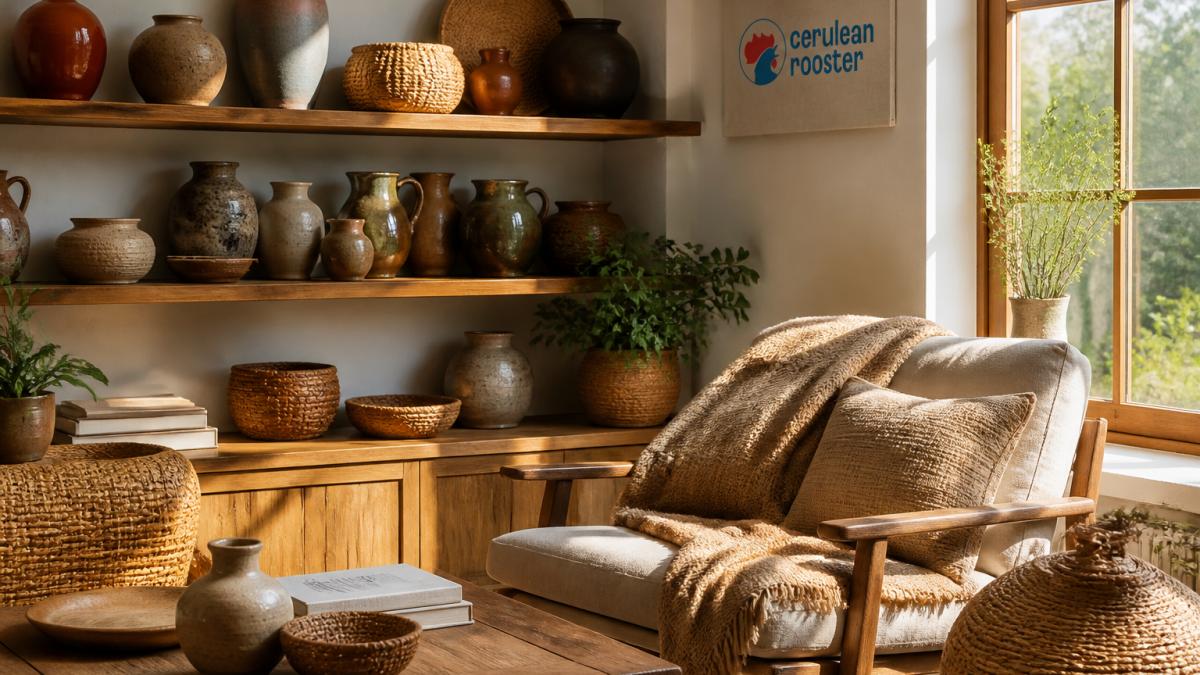
Natural Materials and Finishes
Artisanal interiors favor materials that age beautifully: wood, stone, clay, wool, linen, and leather. They develop patina and character over time rather than looking dated.
Natural materials also bring sensory richness: wood grain varies, stone is never uniform, and handwoven textiles have texture you can feel. That tactile quality makes artisanal spaces feel more inviting and human-scaled than plastic, laminate, or synthetics.
Warm Neutral Color Palettes
Artisanal design embraces warm neutrals: cream, beige, warm gray, soft brown, and muted earth tones. These let handcrafted pieces and textures take center stage, creating a calming backdrop where craftsmanship becomes the visual interest.
Accents tend toward natural hues: terracotta, sage green, rust, or deep indigo, organic rather than synthetic, complementing the natural materials and keeping the space grounded and timeless.
Patterns, Textures, and Layering
Artisanal spaces embrace pattern and texture through natural fabrics and traditional techniques: geometric weaves, hand-dyed textiles, carved wood, and embossed surfaces.
The key is intentionality. A room might combine a hand-loomed rug, embroidered pillows, a carved headboard, and a woven wall hanging, each chosen for its craftsmanship and contribution to the room's warmth.
Modern Artisan Style: Blending Old and New
Contemporary artisanal design doesn't mean your home should look like a museum.
This hybrid approach keeps artisanal spaces from feeling themed or precious.
Modern artisan style works in any home, small apartment or larger house. It's less about period authenticity and more about valuing the human touch and natural materials in everyday surroundings.
Arts and Crafts Interior Design and How It Relates
The Arts and Crafts movement, which emerged in the late 1800s against industrial mass production, is the philosophical ancestor of artisanal style.
But there's a distinction. Arts and Crafts is a specific historical style: heavy wooden furniture, ornate carving, rich jewel tones, nature-inspired patterns.
Think of Arts and Crafts as one expression of artisanal values, while modern artisan style is a looser interpretation prioritizing craftsmanship and natural materials without a specific historical formula.
Handmade Home Decor Ideas for Every Room
Artisan-Style Living Room Design
An artisan-style living room centers on comfort and connection. Anchor it with a substantial wooden coffee or side table with visible grain and honest joinery, layer in a natural fiber rug (jute, sisal, or wool), then add seating upholstered in linen or other natural fabrics in warm neutrals.
Wall decor should emphasize handcrafted pieces: framed textiles, ceramic hangings, or hand-carved shelves displaying ceramics and woven baskets. Choose lighting in natural materials like wood, ceramic, or iron, a handmade pendant or ceramic-based lamp adds warmth and authenticity.
Kitchen and Dining Spaces
Kitchens and dining areas are perfect for functional artisan pieces. Open shelving with hand-thrown pottery, wooden serving boards, and vintage textiles adds interest while staying practical.
Swap mass-produced canisters for handmade ceramic jars, display wooden utensils in a hand-thrown pot, and hang linen tea towels with hand-embroidered details. These small touches add up to a space that feels authentic and lived-in rather than showroom-perfect.
Bedrooms and Personal Spaces
Bedrooms benefit from artisanal style's emphasis on texture and comfort. Invest in quality bedding in natural fibers, linen, cotton, or wool, and layer in handwoven throws, embroidered pillows, and a quality area rug.
Personal spaces like home offices or reading nooks can showcase handcrafted collections. Display books on hand-built shelving, add a handmade textile as wall art, or place a hand-thrown ceramic vessel on your desk, details that make a space distinctly yours.
Sourcing Authentic Handcrafted Pieces
Finding genuine artisan-made pieces is part treasure hunt, part education, the more you handle handmade work, the faster your eye sharpens. Here's a practical framework for sourcing pieces you'll love for decades.
Where to Look First
Start close to home. Local craft markets, studio tours, makers' fairs, and guild exhibitions put you face-to-face with the people who make things.
Regional craft schools and community art centers host seasonal sales where students and instructors sell directly.
Online, look for platforms and directories centered on individual makers rather than drop-shipped goods.
How to Evaluate Craftsmanship in Person
When you're holding a piece, run through these checks:
- Look for tool marks. Hand-carved wood shows chisel or gouge marks. Hand-thrown pottery has subtle throwing rings. Hand-forged metal has hammer dimples. These aren't flaws, they're signatures.
- Check the joinery. Dovetails, mortise-and-tenon joints, and hand-cut finger joints signal real woodworking skill. Staples, screws driven at odd angles, or heavy glue lines are shortcuts.
- Feel the finish. A hand-rubbed oil or wax finish feels dry and warm, not slick or plastic. Run your fingers along edges, they should be smooth but not machine-perfect.
Evaluating Provenance and Ethics
Provenance is the story of where something came from and who made it.
Ask sellers directly: Who made this? Where? How long did it take? A fair answer names a person or small workshop.
Look for certifications or memberships indicating agreed standards, guild membership, fair-trade labeling on imported textiles, or a commitment to sustainably harvested wood.
Red Flags for 'Handmade-Style' Products
Mass-produced items increasingly mimic handmade work. Watch for:
- Suspiciously uniform 'imperfections.' Real variation is random. A row of identical 'rustic' dents is a mold.
- Prices that don't match the labor. If a piece would take a skilled maker many hours to produce and the price is very low, something is off.
- Photos that don't match the product. Request additional photos of the actual item, not a stock image.
Building Relationships Over Time
One of the quiet pleasures of artisanal style is that your home becomes a record of relationships, the potter you met at a spring fair, the woodworker who built your dining table, the weaver whose runner sits in your hallway.
At Cerulean Rooster, that chain of care is personal. We're deaf brothers who make every card, sticker, portrait, and commission by hand, and expressive art is how we communicate.
Common Mistakes and How to Avoid Them
Even people who love handmade things can end up with a room that feels heavy, cluttered, or themed. The difference between a collected artisanal home and a chaotic one comes down to a few avoidable mistakes.
Mistake 1: Treating Artisanal Style as a Shopping List
The fastest way to make a room feel artificial is buying 'artisanal' items because they fit a category rather than because you love them.
The fix: Buy less, choose slower. Before purchasing, ask two questions: Does this piece do something in the room (function, texture, color, memory)? Would I still want it if it weren't labeled 'artisanal'?
Mistake 2: Confusing Layering with Clutter
Layering is a hallmark of artisanal style, stacked textiles, mixed rugs, grouped ceramics, but without editing it tips into clutter fast, making the room feel like a storage unit for nice objects.
The fix: Use the 'one in, one out' rule for display surfaces. Every time you add a new piece to a shelf or table, remove one.
Mistake 3: Fighting Over Wood Tones
Mixing wood tones is a common source of visual chaos. A honey oak floor, cherry sideboard, walnut coffee table, and painted pine shelf can each be beautiful but compete when placed together without a plan.
The fix: Choose a dominant wood tone and let it occupy the largest surfaces, floors, big furniture, built-ins. Then introduce one or two secondary tones in smaller pieces, a stool, a frame, a bowl.
Mistake 4: Forgetting Contemporary Anchors
An all-artisanal room can feel like a period piece or museum. Without a few clean, contemporary elements, it reads as 'themed' rather than 'lived in.'
The fix: Anchor the room with at least one or two contemporary pieces, a simple sofa with clean lines, a modern floor lamp, a plain linen curtain panel.
Mistake 5: Neglecting Lighting
Handmade details, wood grain, woven texture, glazed ceramic, disappear in flat, cool light. A room full of beautiful objects under a single overhead fixture can feel cold and flat.
The fix: Layer warm lighting at three heights: overhead (a pendant or chandelier), mid-level (table and floor lamps), and low (candles, small accent lamps).
Mistake 6: Skipping the Edit
Artisanal homes evolve. Pieces come in, pieces go out, rooms get rearranged. The mistake is never editing, letting every purchase stay forever regardless of whether it still fits.
The fix: Once or twice a year, walk through each room and ask of every object: Does this still earn its place? If not, move it to another room, store it, gift it, or donate it.
At Cerulean Rooster, we think about this every time we make a card, sticker, portrait, or commission. Expressive art is our medium of communication, and we're deaf brothers who build each piece to feel personal and thoughtful, not mass-produced. The same applies to your home: fewer pieces, chosen with care, made by real people, will always beat a room full of things bought to fill space.
Frequently Asked Questions
What is artisanal interior design style?
Artisanal interior design style celebrates handmade, crafted pieces and natural materials that showcase human skill and creativity. It emphasizes authenticity, warmth, and personality over mass production. The style values visible craftsmanship, think handwoven textiles, hand-thrown pottery, and hand-carved wood, creating spaces that feel collected, lived-in, and genuinely personal rather than sterile or commercially designed.
How is artisanal interior design different from Arts and Crafts?
While both styles celebrate craftsmanship and reject mass production, Arts and Crafts is a specific historical movement from the late 1800s with particular design rules: geometric patterns, specific wood types, and architectural elements. Artisanal style is broader and more flexible, it can blend traditional handmade pieces with modern lines, contemporary art, and global influences. You can create an artisanal space without following strict Arts and Crafts principles.
What materials are commonly used in artisanal interiors?
Artisanal design relies on natural, unrefined materials: solid wood (oak, walnut, reclaimed timber), stone, clay, wool, linen, cotton, and leather. These materials age beautifully and often improve with time and use. Handcrafted finishes like natural oils, wax, and hand-applied stains are preferred over synthetic coatings. The imperfections and variations in these materials, knots in wood, color shifts in textiles, are celebrated as evidence of authentic craftsmanship.
Can I add artisanal style to a modern home?
Absolutely. Modern artisan style blends clean lines and minimalist layouts with handmade, textured pieces. Start by choosing a few statement pieces, a hand-thrown ceramic vessel, a woven wall hanging, or reclaimed wood furniture, and pair them with contemporary elements. This creates visual interest without overwhelming the space. The key is balance: let handmade items breathe rather than filling every surface.
How do I avoid making an artisanal room feel cluttered or overly themed?
The difference between 'collected' and 'cluttered' is intentionality and breathing room. Choose pieces you genuinely love rather than buying anything handmade. Leave negative space on shelves and walls. Stick to a cohesive color palette of warm neutrals so diverse pieces feel unified. Edit ruthlessly, if something doesn't serve the space or tell part of your story, it doesn't belong. Quality and restraint beat quantity.
What colors work best in an artisanal-style room?
Warm neutrals are the foundation: creams, taupes, warm grays, soft browns, and muted ochres. These create a calming, sophisticated backdrop that lets handmade textures and pieces shine. Layer in deeper tones like charcoal or forest green for contrast, and add warmth with terracotta, rust, or warm gold accents. The goal is a cohesive, grounded palette that feels timeless rather than trendy.
Where can I find authentic handmade pieces for my home?
Look for small makers, artisans, and family-run studios that create original work. Local craft fairs, maker markets, and independent online shops often feature genuine handcrafted items where you can learn directly from creators about their process and materials. Visit studios when possible to see the work firsthand. Ask questions about how pieces are made, authentic artisans are happy to share their craft and story.
How do I care for natural materials in an artisanal home?
Natural materials require thoughtful care to age beautifully. Wood benefits from occasional oiling or waxing to protect the finish. Textiles like wool and linen should be gently cleaned and aired regularly. Stone and ceramic develop a patina over time, which adds character. Avoid harsh chemicals; use mild soaps and natural cleaners. The goal is maintenance that honors the material's integrity, allowing it to age gracefully rather than stay artificially pristine.